


In physics, motion changes when force acts over time, and that change is explained by the impulse formula. If you have ever seen a car crash test, a football kick, or a rocket launch, you have already seen impulse in action. This guide explains the impulse formula in clear steps, with deep details and solved problems, so you can fully understand how force, time, and momentum work together.
What Is Impulse in Physics?
Before using the impulse formula, we must understand impulse itself. Impulse is the effect of a force acting during a time interval. It tells us how much the momentum of an object changes because of that force.
In simple words, a strong force for a short time can give the same result as a small force for a long time. This idea is very important in safety systems like airbags, helmets, and car crash tests. They increase impact time to reduce force.
Impulse Formula Physics and Force-Time Relation
The basic impulse formula physics students learn is simple. When force is constant, impulse equals force multiplied by time. That means if you double the time, you double the impulse.
Mathematically, impulse equals force times time interval. This version of the impulse formula physics force time is common in school problems, labs, and many exam questions.
Momentum and Impulse Formula Connection
The impulse formula is strongly linked to momentum. In fact, impulse equals the change in momentum. This idea is called the Impulse–Momentum Theorem, one of the most important facts in mechanics.
Momentum is mass multiplied by velocity. So when velocity changes, momentum changes. The impulse formula with momentum shows that impulse equals final momentum minus initial momentum.
What Is the Impulse Formula in Mathematical Form?
Many students ask, what is the impulse formula exactly? There are two main forms. One uses force and time. The other uses change in momentum.
When force is constant, impulse equals force times time. When velocity changes, impulse equals mass times change in velocity. Both forms describe the same physical idea.
Units and Physical Meaning
The impulse formula gives results in newton-seconds. But this unit is also equal to kilogram meter per second, which is the unit of momentum. This shows the deep link between impulse and momentum.
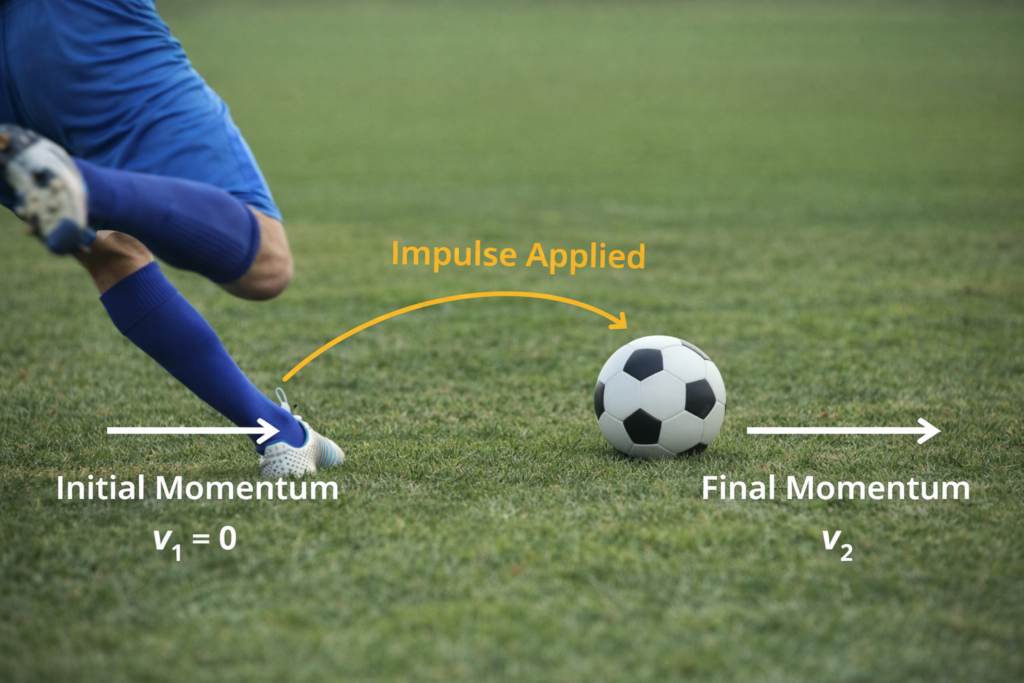
Physically, impulse measures how much motion is transferred. If a ball is at rest and you kick it, the impulse determines how fast it starts moving.
Magnitude of Impulse Formula
Sometimes we only care about size, not direction. In that case, we use the magnitude of impulse formula. It focuses on how big the momentum change is, ignoring signs.
For example, if a ball reverses direction after hitting a wall, the change in velocity is large. So the impulse magnitude is large as well.
Linear Impulse Formula and Net Impulse Formula
When motion is in a straight line, we often use the linear impulse formula. It simply describes impulse in one direction along a line.
But in real life, more than one force may act at the same time. Then we use the net impulse formula. Net impulse equals the change in total momentum of the object.
Total Impulse Formula in Collisions
During collisions, forces can change quickly. In events like car crashes, sports tackles, and hammer hits, impulse plays a central role.
The total impulse formula says that the total impulse during the collision equals the overall change in momentum. This is why crash engineers study impulse carefully.
Impulse Formula Triangle and Force-Time Graph
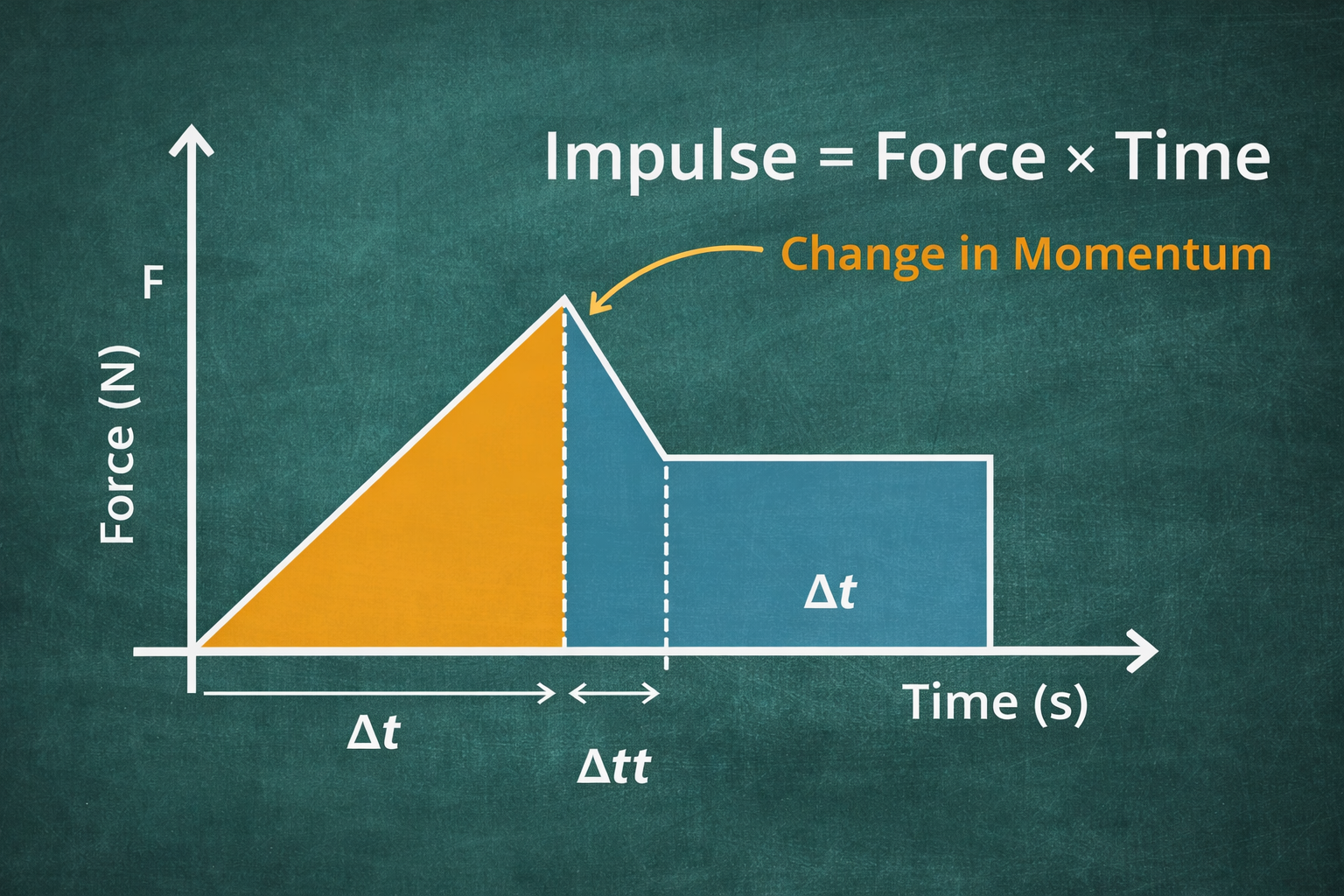
Another powerful way to understand the impulse formula is through graphs. If you draw a force versus time graph, impulse equals the area under the curve.
If the graph forms a rectangle, the area is simple. If the graph forms a triangle, like in many short impacts, we use half times base times height. This is known as the impulse formula triangle idea.
Impulse Formula Integral for Variable Force
Not all forces stay constant. During real impacts, force changes every moment. In such cases, the impulse formula integral is used.
This advanced version calculates the area under a changing force curve. Even in this case, the final result still equals the change in momentum. That deep connection always remains true.
Impulse Formula in Physics Applications
The impulse formula in physics is not just theory. It explains how rockets launch, how athletes improve performance, and how safety systems reduce injury.
In sports like baseball, football, and cricket, players increase contact time to control force. In engineering, designers study impulse to protect passengers.
Angular Impulse Formula in Rotational Motion
Impulse is not limited to straight motion. There is also an angular impulse formula used in rotation.
In rotating systems, torque replaces force and angular momentum replaces linear momentum. Angular impulse equals torque times time, and it equals the change in angular momentum.
This concept is important in figure skating spins, spinning wheels, and machinery systems.
Specific Impulse Formula in Rocket Science
The specific impulse formula is different from collision impulse. It is used in rocket science to measure engine efficiency.
In space programs like NASA missions, specific impulse shows how effectively a rocket uses fuel. Higher specific impulse means better fuel efficiency.
Although it uses the word impulse, it focuses on thrust and fuel flow instead of simple collision effects.
Impulse Formula AP Physics 1 Perspective
In AP Physics 1, students often solve problems using average force and time. The impulse formula AP physics 1 version focuses on impulse equals average force times time.
Students also connect it with momentum conservation in collisions. Many exam questions combine impulse and conservation laws together.
Understanding the impulse formula clearly helps in solving free response questions and multiple choice problems.
Deep Concept: Why Increasing Time Reduces Force
A key idea behind the impulse formula physics force time relation is that impulse stays fixed if momentum change is fixed.
If you increase stopping time, the average force decreases. This is why airbags, seat belts, and padding materials are life-saving inventions.
This principle is based on the impulse formula and is supported by experimental crash data.
Step-by-Step Solved Problem 1
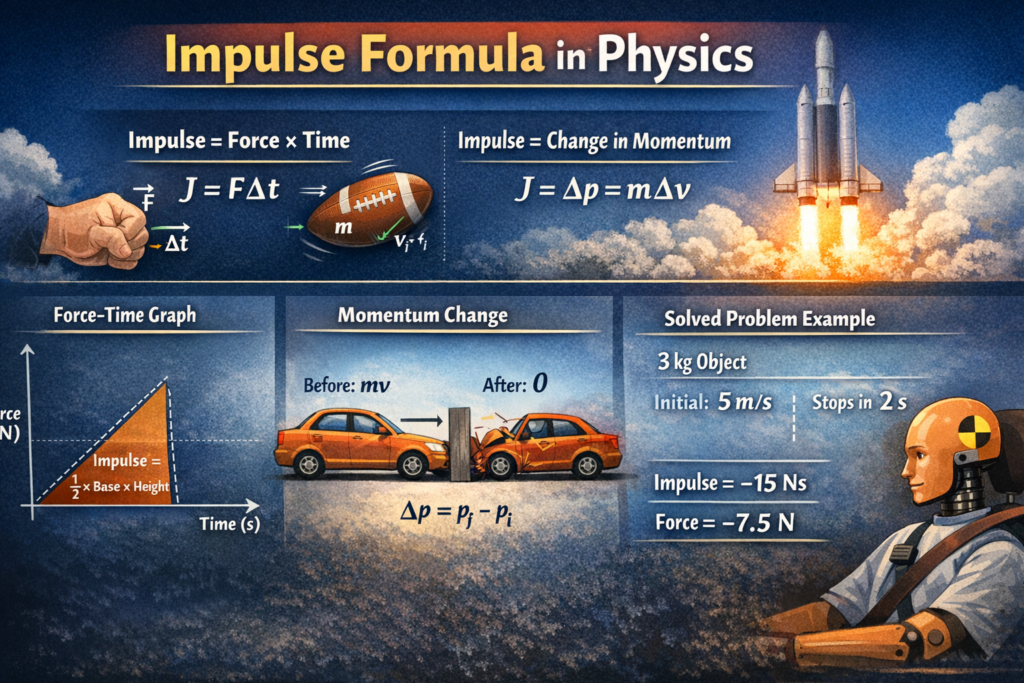
A 3 kg object moves at 5 m/s and stops in 2 seconds due to a constant force. First, find change in momentum using the impulse formula.
Initial momentum equals 3 times 5. Final momentum equals zero. So impulse equals negative fifteen newton-seconds.
Then find force by dividing impulse by time. The average force equals negative seven point five newtons.
Step-by-Step Solved Problem 2
A ball of mass 1 kg moves at 8 m/s and rebounds at 6 m/s in the opposite direction. Using the impulse formula with momentum, calculate impulse.
Take initial velocity as positive eight. Final velocity is negative six. Change in velocity equals negative fourteen.
Multiply by mass. Impulse equals negative fourteen newton-seconds. The negative sign shows direction change.
Step-by-Step Solved Problem 3 with Triangle Graph
A force rises from zero to 40 newtons over 4 seconds in a straight line. The force-time graph forms a triangle.
Using the impulse formula triangle method, area equals half times base times height. So impulse equals half times four times forty.
The answer equals eighty newton-seconds.
Common Mistakes Students Make
Many students confuse force with impulse. Force is instant, while impulse includes time. The impulse formula makes this clear.
Another mistake is ignoring direction. Since impulse equals change in momentum, direction always matters in calculations.
Why the Impulse Formula Matters in Real Life
The impulse formula explains safe driving, sports performance, rocket launches, and machine design.
From car crash testing labs to rocket launch pads, impulse calculations help engineers reduce risk and improve performance.
Without the impulse formula, modern safety and transportation systems would not be as advanced as they are today.
Frequently Asked Questions (FAQs)
1. What is the impulse formula in physics?
The impulse formula states that impulse equals force multiplied by time, and it also equals the change in momentum.
2. How is impulse related to momentum?
Impulse is equal to the change in momentum. If momentum changes, impulse has occurred.
3. What is the unit of impulse?
The unit of impulse is newton-second (N·s), which is also equal to kilogram meter per second.
4. When do we use the impulse formula integral?
We use the integral form when force changes with time instead of staying constant.
5. Why is impulse important in real life?
Impulse explains car crashes, airbags, sports impacts, and rocket motion by linking force and time.
Conclusion
The impulse formula is one of the most powerful tools in mechanics. It connects force, time, and momentum in one simple idea. Whether using constant force, the impulse formula integral, or the net impulse formula, the result always links to change in momentum.
By understanding the impulse formula deeply, you can solve collision problems, analyze safety systems, and explain real-world motion with confidence. Mastering this concept builds a strong foundation for advanced physics and engineering studies.
For More Interesting Information Visit: CDPCS NEWS
